
How to follow up on a painting estimate
A four-step follow-up schedule with email templates, so every open quote has a clear next step without pressuring the homeowner.

Send the estimate with a clear next step. Check that it arrived after a couple of business days, follow up again around the time the homeowner expects to decide, and send one final note if you still have not heard back. Adjust the timing to what you discussed, and stop when the homeowner responds or asks you not to contact them.
A follow-up should make it easier for the homeowner to decide. It should not feel like pressure or another "just checking in" email.
Set up the follow-up before you leave the estimate visit
Ask when the homeowner hopes to make a decision and how they prefer you to follow up. Write down the answer. If they are comparing bids or waiting on a date, follow up when that decision is expected.
Before sending the estimate, check that it clearly explains:
- Rooms and surfaces included
- Prep, coats, colors, and products
- What is excluded
- Price and any options
- How to accept the estimate
- What happens next, including how a start date is reserved
A follow-up cannot fix a quote that leaves the homeowner unsure what the price covers. Use the painting estimate checklist to make sure nothing is missing.
A simple follow-up schedule for painting estimates
Use this as a starting point. A large project may need a different conversation than a one-room repaint. The timing the homeowner gave you should guide the schedule.
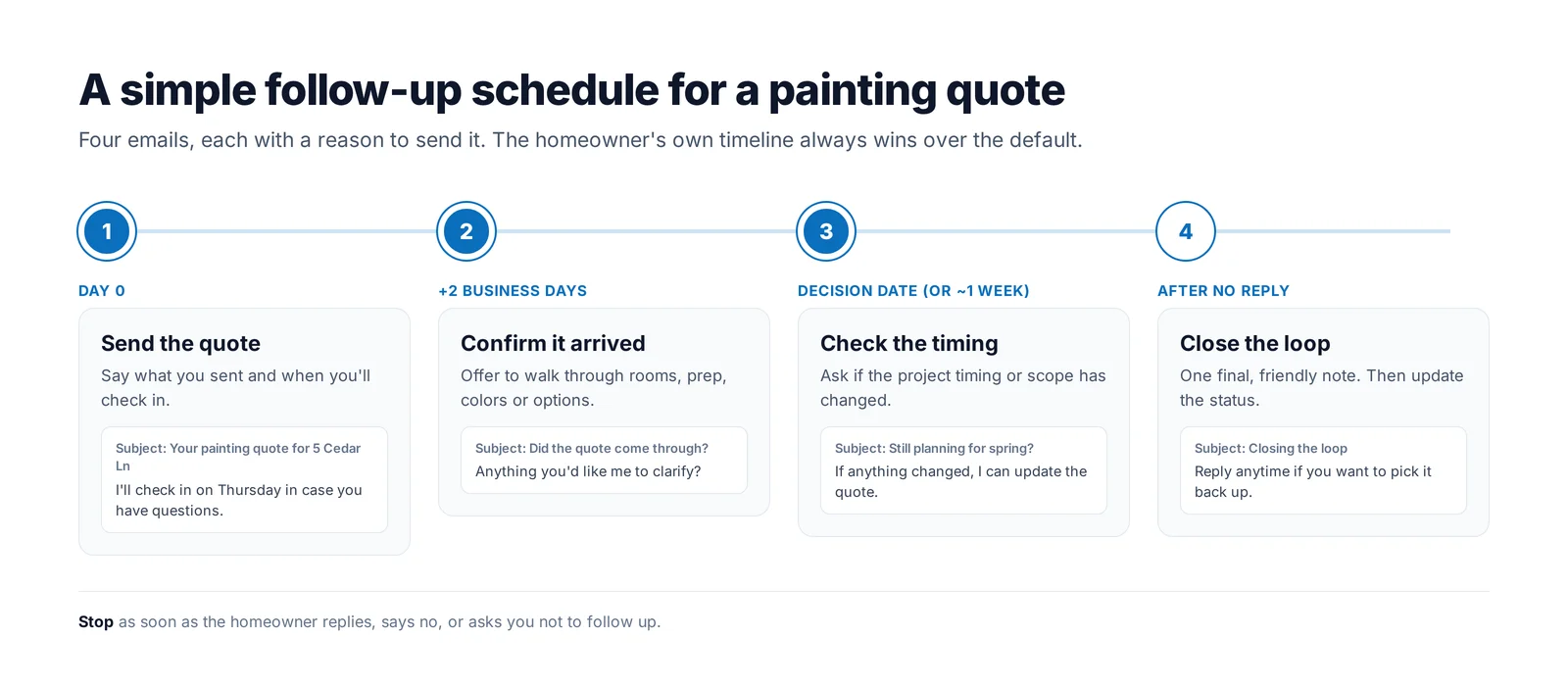
Follow-up date planner
- 1Send the estimateSay what you sent and when you'll check in
- 2Confirm it arrivedOffer to walk through rooms, prep or colors
- 3Check the timingAbout a week after sending
- 4Close the loopOne final note, then update the status
When you send the estimate
Tell the homeowner what you sent and when you will check in.
Hi [Name], I just sent the estimate for [project]. It covers [brief scope]. Take a look when you have a chance. I'll check in on [day] in case you have questions.
Two business days later
Make sure the estimate arrived and offer to clarify the work.
Hi [Name], did the estimate for [project] come through? I'm happy to walk through the rooms, prep, colors, or options with you. Is there anything you'd like me to clarify?
If the homeowner already confirmed they received it, skip the delivery check and ask whether anything in the scope needs an explanation.
Around the homeowner's decision date
Bring the conversation back to their timing. If they did not give you a date, a follow-up about a week after sending the estimate is a reasonable starting point.
Hi [Name], I'm checking back on the painting estimate. Are you still hoping to do the project around [timeframe]? If the scope or timing has changed, let me know and I can update the estimate.
If they are ready to move forward, explain the next step in your process. Do not describe a date as confirmed until the conditions in your agreement, such as approval or a required deposit, are met. See how to collect residential painting deposits.
Close the loop
If you have not heard back after a couple of useful follow-ups, send one final note and update the estimate's status.
Hi [Name], I haven't heard back, so I'll close the loop on this estimate for now. If you want to revisit the project later, reply here and we can pick it back up. Thanks for considering us.
If the homeowner says no, thank them and mark the estimate as declined. If they ask you not to follow up, stop.
Make each message useful
Before sending another message, ask: What would help this homeowner decide?
You might:
- Explain what is included in the price
- Clarify prep, paint, or color options
- Confirm whether the project timing changed
- Revise the estimate if the scope changed
- Answer a question about access or how the crew will work in the home
What did the homeowner say?
Wait for the next date on your plan. Don't send a second message early.
Set status to WaitingDraft your reply email
Uses the next step above. Nothing is sent — you review it, edit it, and copy it into your own email.
Avoid sending the same message repeatedly or offering a discount before you understand the concern. If the homeowner is waiting on another decision, record it and follow up at the agreed time.
Keep a short record of every open estimate
For each estimate, track:
- Date sent
- Status: waiting, question received, approved, declined, or paused
- Last contact and what you discussed
- Next follow-up date
- Any change to scope, timing, or decision-maker
Open estimate tracker
| Homeowner | Status | Last contact | Next follow-up |
|---|---|---|---|
Status: waiting · question received · approved · declined · paused
A simple list can do the job. The important part is that every open estimate has a clear next step and someone responsible for it. When the homeowner makes a decision, update the status so old quotes do not look active forever.
An open quote needs a next step
- Step 1 of 3
Record the reply
Question, decision date, changed timing, approval or decline.
- Step 2 of 3
Set the status
Keep the record aligned with what the homeowner actually said.
- Step 3 of 3
Set the next date
Answer the question or follow up at the agreed time—not every day.
If they decline or ask you to stop, close the record and stop contacting them.
Common painting estimate follow-up mistakes
- Following up before checking the quote. Make sure the homeowner received the complete estimate.
- Sending only "just checking in." Ask a real question or offer a useful next step.
- Following a fixed cadence when the homeowner gave you a timeline. Use the date they shared.
- Treating silence as a yes. Keep the estimate open only while there is a real next step.
- Promising a start date too early. Be clear about what must happen before the schedule is reserved.
- Continuing after a clear no or stop request. Update the record and move on.
Keep the estimate connected to the next step
Following up works best when the estimate, last conversation, and next action stay together. dropcloth keeps the inquiry and quote on the same job record, alongside the schedule, crew details, and payment.
Keep reading
How to Collect Residential Painting Deposits
Define what each payment covers, when it is due, and how it counts toward the job total. A practical checklist for residential painting contractors.
Painting Estimate Checklist: What to Include Before You Send a Quote
A walkthrough checklist for rooms, surfaces, prep, finish plan, exclusions, schedule and changes — so the homeowner and your crew see the same job.
How to Schedule Residential Painting Jobs and Crews
Confirm the job is ready, plan crew days from the work, give homeowners a start window you can keep, and handle changes from one current plan.